Most factories don't check every product. They check a sample and trust it to speak for the batch. Usually that works. Then one day a customer overseas opens a box and finds the scratch your sample never saw, or the missing screw that walked past the QC bench at 2 a.m. AI visual inspection closes that gap: every unit, every cycle, judged the same way.
Why manual visual QC breaks down
Human inspectors are good for about ninety minutes. After that, fatigue, changing light and sheer repetition turn judgement into guesswork. Two inspectors grade the same part differently, and the night shift grades it differently again. A rested inspector might hit 95% accuracy on a simple pass/fail in good light; six hours into a night shift under fluorescent tubes, that can drop closer to 80%. Sampling keeps the cost down but bakes the risk in: a 1% defect rate means ten bad units in every thousand you ship, and every one is a possible claim, return or lost account.
What AI visual inspection actually is
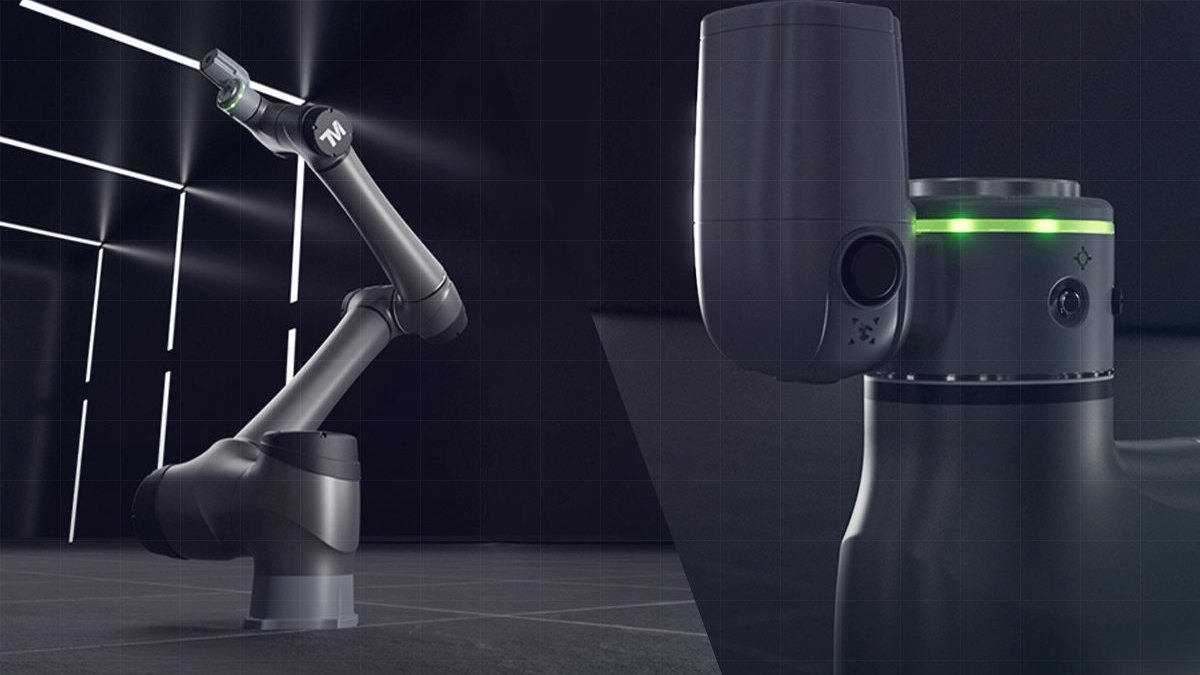
The TM AI Cobot's vision system runs four families of AI model alongside classic machine-vision tools, all trained on your parts:
- Image classification — is this unit OK or NG, and which variant is it?
- Object detection — find and locate every component, screw or connector in frame.
- Anomaly detection — learn what "good" looks like from a handful of samples, then flag scratches, dents and contamination it has never seen before.
- Segmentation — pixel-level defect mapping for surfaces, coatings and labels.
- OCR & barcode reading — lot codes, serial numbers and labels, read and cross-checked automatically.
Built-in beats bolt-on
Traditional robot vision means a camera from one vendor, a controller from another and software from a third, plus an integration project to make them talk. The TM AI Cobot puts a 5 MP auto-focus camera with its own lighting inside the arm and runs everything in TMflow. One vendor, one program, cables routed internally. There's no handshaking code to debug and no compatibility list to manage. And because the camera moves with the wrist, a new inspection angle is a taught position, not a new mounting bracket. In practice that's the difference between two to four hours to add a viewpoint and two to four weeks.
Train your own model in an afternoon
TM AI+ Trainer runs in a browser and turns factory photos into a working model. You don't need a Robot automation team:
- Collect — capture images of good and defective units straight from the cobot's camera. Thirty to a hundred is a normal starting set.
- Annotate — mark the defects or regions in a simple click-and-drag interface.
- Train — start the run, watch the accuracy climb, adjust if needed. Five to thirty minutes for a simple model.
- Deploy — push the model to the robot or a TM AI+ AOI Edge station and start inspecting.
The images stay in your own local database. Classified production data never leaves your network — which, for a lot of Indonesian factories running customer-specific parts, is a contract requirement rather than a nice-to-have.
Where it fits on your line
Four patterns cover most of what we deploy in Indonesia:
- End-of-line 100% check. The cobot sits between the last process step and packing. Every part is inspected before it goes in the box; NG parts route to a reject bin. Typically 8–15 parts a minute for 100–300 mm parts.
- In-process check. Mounted next to the machine, the cobot picks, places and inspects in the same motion — catching tool wear before it makes a batch of scrap.
- Standalone rework station. For lower volumes, operators place parts in front of the cobot; it inspects and signals the verdict.
- First-article inspection. After a setup change, the first part off each machine is checked before the line ramps. This one alone often pays for the cell inside a year.
Traceability comes for free
Every inspected unit leaves a record. TM Image Manager stores each inspection image, searchable by time, work order or barcode, with real-time monitoring and a human double-check station for borderline calls. When a customer questions a shipment, you answer with the picture of that unit instead of an apology. A documented 100% inspection process is also what clears customer audits — often worth more than the direct scrap saving.
What 100% inspection is worth
Here is the arithmetic from a typical Indonesian auto-parts supplier. They made 50,000 parts a month at a 2% defect rate and caught about 95% by sampling — so roughly 50 bad parts a month still reached customers. At around US$80 per return event in handling alone, that's US$4,000 a month before you count the damage to the relationship.
After a TM AI Cobot inspection cell went in, defect escapes fell below 0.1% and returns dropped to one or two events a month. Direct saving: about US$3,500 a month, or US$42,000 a year. On a US$60,000 cell, that's payback in under 18 months — before counting lower insurance exposure, cleaner audits, and the scrap you avoid by catching a drifting tool at part 10 instead of part 200.
"Sampling tells you how the line was doing. 100% AI inspection tells you how every single unit did."
The objections we usually hear
"We don't have a data-science team." You don't need one. The operator who does manual QC today can train a model after a half-day workshop. It's closer to teaching a colleague a new task than to programming.
"Our defects are too varied to define." That's exactly where anomaly detection earns its place. You teach the system what good looks like and it flags everything that isn't — including defect types you've never catalogued.
"What if the AI gets it wrong?" So does a human, more often and less predictably. The difference is that the cobot's accuracy is measurable and monitored: every cell ships with a daily dashboard of false-positive and false-negative rates, so you can see exactly how it's doing.
See your own defects detected live
Bring your OK and NG samples and we'll train a model on them in front of you.
Book an inspection demo